I haven't been in class recently (so sorry about that!), so I don't really know much about what's been discussed, but I have been reading Technology and Literacy in the Twenty-First Century by Cynthia L. Selfe on my own time, and I just sort of find it funny that we're reading a book on modern technology that was written in 1999...over 13 years ago. At first I thought it couldn't really be all that relevant, with the way technology develops so quickly, but at that point most of us in the class were really too young to know the issues and debates that were going on about technology in that time period. We were sort of born into this rise of the Internet and computers and it has developed and matured with us, so many of us probably wonder why it's even being debated. We (or at least I) didn't or still don't understand how much societal change has occurred in our lifetime because of the rise of the computer and Internet age.
I didn't realize that all these debates were going on at all. Some of the arguments the book tries to make seem so backward to me now that we're 13 years in the future and now some of their fears have been disproved. I don't really like how, in the second chapter of the book, someone suggests that using computers or the Internet for anything other than schoolwork or research or very official, dryly academic objectives is some kind of moral faux pas. Using something for entertainment isn't some kind of misuse, the way whoever said this is implying. That just sort of rubbed me the wrong way, I guess. And, oftentimes, entertainment and education overlap--which I think is usually the case with modern technology. And what about art? That definitely can take the form of what many people consider useless entertainment. There is a fine line here.
Just my two cents about the book so far...
Thursday, February 2, 2012

Wednesday, February 1, 2012
Why the Internet isn't Reaching its Full Potential
Last week, I discussed how the Internet is a global village we all contribute to. Today, I'll attempt to explain why this hasn't quite caught on and why the majority of the Internet's population isn't using the Internet to its full potential.
In years before the Internet, we were always limited by our medium. Books could only hold so many words, cassette tapes could only have a few hours of audio if we were lucky, and VHS's typically only had one movie on them with little or no bonus features. (In the cases of large movies like Titanic, you had two tapes.)
This is becoming less and less so with the fantastic electronic media that we have today. Sure we're still limited to our hard drives and servers as far as our movie and music collection, but as far as text is involved, we have virtually unlimited space to work with.
Despite this, it seems that many of the users on the Internet aren't taking advantage of the great power that we have. Of course, there are problems with the sites themselves, (YouTube and Twitter limiting the number of characters on comments and posts respectively) but the real problem seems to lie in the fact that we popularized the Internet while the television was the largest medium of mass communication at the time. Short news bits are what we are used to, and we perceive that we have little time to read.

In years before the Internet, we were always limited by our medium. Books could only hold so many words, cassette tapes could only have a few hours of audio if we were lucky, and VHS's typically only had one movie on them with little or no bonus features. (In the cases of large movies like Titanic, you had two tapes.)
This is becoming less and less so with the fantastic electronic media that we have today. Sure we're still limited to our hard drives and servers as far as our movie and music collection, but as far as text is involved, we have virtually unlimited space to work with.
Despite this, it seems that many of the users on the Internet aren't taking advantage of the great power that we have. Of course, there are problems with the sites themselves, (YouTube and Twitter limiting the number of characters on comments and posts respectively) but the real problem seems to lie in the fact that we popularized the Internet while the television was the largest medium of mass communication at the time. Short news bits are what we are used to, and we perceive that we have little time to read.

In case you didn't know, TLDR stands for "Too Long, Didn't Read."
I feel strange talking about my generation as if I am an outsider, but in many ways I feel so different from the majority of the 18-25 demographic. I'm not hooked on reality television or pop music. I prefer my media with a little meat and substance. Of course, this doesn't mean I don't like browsing through LOLcats or memes every once in a while, but I don't spend an hour looking at them on TV or listening to remixes of "Do a Barrel Roll" like it's art.
I guess I'm just disappointed at the fact that we have so much potential to change our world with the internet, but we're still caught up in our inability to process anything longer than a full page of single-spaced text before feeling fatigued enough to say, "tl;dr."
I guess I'm just disappointed at the fact that we have so much potential to change our world with the internet, but we're still caught up in our inability to process anything longer than a full page of single-spaced text before feeling fatigued enough to say, "tl;dr."
Tuesday, January 31, 2012
Simplifying Policies
Up until Gmail tried constantly to flag my attention about a new change they made to Gmail privacy policy, I denied that our society has a shorter attention span than in the past. Not only was the change that Google made interesting in itself, but they knew they would have to try several different methods to make sure I saw the change whether it was redirecting me to a new page right after I signed in or little bubbles poppping up in my email notifying a new change that I should read. What was that change? I got a screen shot of it:
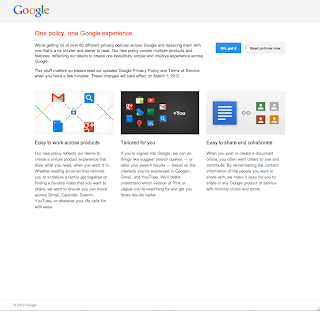
If you can't read the small text, let me sum it up for you, "We are getting rid of over 60 different privacy policies across Google and replacing them with one that's a lot shorter and easier to read." Let that sink in for a moment.
That's the equivalent of telling people "You can't read all of the amendments? Here, let's make a picture book out of it. It's pretty much the same thing." Anyone else nervous? How much information can you fit in a simple privacy policy? I admit, I haven't actually looked at the privacy policy, but just the thought that corporations are dumbing it down for us makes me reconsider my dismissive attitude.
The more simple the policies are, the more loopholes can be found. Even if there are policies that we haven't read every single word of, they still exist and considered valid so if something happens, we can point to it and say it was in the policy. If Google is actually deleting the privacy policy and replacing it with a simpler one, we don't have the more extensive policy to fall back on if we need to. Again, that's like getting rid of the amendments and instead making them into one sentence bullet points. Creating a bullet point list is fine so we understand the gist of the amendments, but to get rid of the solid foundation of it would be unthinkable.

If you can't read the small text, let me sum it up for you, "We are getting rid of over 60 different privacy policies across Google and replacing them with one that's a lot shorter and easier to read." Let that sink in for a moment.
That's the equivalent of telling people "You can't read all of the amendments? Here, let's make a picture book out of it. It's pretty much the same thing." Anyone else nervous? How much information can you fit in a simple privacy policy? I admit, I haven't actually looked at the privacy policy, but just the thought that corporations are dumbing it down for us makes me reconsider my dismissive attitude.
The more simple the policies are, the more loopholes can be found. Even if there are policies that we haven't read every single word of, they still exist and considered valid so if something happens, we can point to it and say it was in the policy. If Google is actually deleting the privacy policy and replacing it with a simpler one, we don't have the more extensive policy to fall back on if we need to. Again, that's like getting rid of the amendments and instead making them into one sentence bullet points. Creating a bullet point list is fine so we understand the gist of the amendments, but to get rid of the solid foundation of it would be unthinkable.
Friday, January 27, 2012
An Interconnected World
As we have been talking in class the past week, the main topic that has been dwelling on me is the idea of our interconnected world. A world where just a couple of decades ago the way that humans communicated, connected, and interacted with each other was completely different. Within my generation it is difficult for me to imagine what life would be like without the Internet or the portable electronic devices which so many of us rely on daily. Has this change also effected the way we learn? I believe it has. Without the use of the Internet the act of finding information takes up so much more time. The fast paced ability and multi-tasking of every college student is what separates us from past generations.
In the past people would study and major in one to two areas during undergrad. It is not uncommon now for someone to have several major areas of study along with a couple minors. I remember one of the first things that one of my professors said to me in one of my first classes here at Ball State.
"What you learn this year and next will most likely be obsolete by the time you graduate." This is a true statement. The world changes at a rapid pace. I believe this is what we need to understand. The discussion we had on Wednesday about the two goals in which the university has for us directly relate to this idea. First of course is the development of proper educated citizens, which without gaining that you can't expect much in this current job market. And second more importantly critical thinking. Critical thinking involves using skillful judgement to obtain the essential meaning or truth. With an ever changing world we must always continue to learn, and without critical thinking one would never be able to teach oneself.
Thursday, January 26, 2012
School, Media, and Laws
It's so interesting to see how all my classes are tying in with one another this semester! For example, in here we read The Medium is the Massage by Marshal McLuhan, which asserted the idea that "The media work us over entirely". This, to my knowledge, means that our society is shaped by not only the messages the media deliver, but also by the media that are delivering these messages. Examples of this include the idea that reading encourages one type of thinking, while the Internet encourages another.
In my fiction class, we recently read Fahrenheit 451 by Ray Bradbury, which is centered around a society in which books are burned and only a certain type of entertainment--one that discourages independent thought--is allowed. As we were given the first reading assignment from this book, my professor exclaimed "This isn't science fiction anymore! This is real life!" I suppose he meant that today, many people no longer read books unless they have to; they prefer other forms of media, such as television or the Internet. If what McLuhan states in The Medium is the Massage is true, then this has changed our society's collective way of thinking. Two of my professors even used the same example of this, when they pointed out that even today's political debates are more a form of entertainment than what they were a few hundred years ago--that is, 7 hour speeches for which people sat patiently. Today, there are few people--few Americans, at least--who could stomach anything that required such sustained attention.
And then there is the issue of SOPA (Stop Online Piracy Act), that wanted to completely shut down (at least in the United States) several websites, such as YouTube, Facebook, and Tumblr, illegal, as well as the sharing of any copyrighted information through the internet. If McLuhan's media = massage assertion is in any way true, (and it appears to be,) this would essentially put our society back about ten years into the past. Even if some people rarely use the internet, it would still affect the spread of knowledge and cultural thought in general, and would indirectly affect these people. To me, the idea of such a law is not only inconvenient, but also chilling--What it would do, essentially, is restrict the flow of knowledge between people. To me, to make sharing information illegal is more a crime than watching a YouTube video.
In my fiction class, we recently read Fahrenheit 451 by Ray Bradbury, which is centered around a society in which books are burned and only a certain type of entertainment--one that discourages independent thought--is allowed. As we were given the first reading assignment from this book, my professor exclaimed "This isn't science fiction anymore! This is real life!" I suppose he meant that today, many people no longer read books unless they have to; they prefer other forms of media, such as television or the Internet. If what McLuhan states in The Medium is the Massage is true, then this has changed our society's collective way of thinking. Two of my professors even used the same example of this, when they pointed out that even today's political debates are more a form of entertainment than what they were a few hundred years ago--that is, 7 hour speeches for which people sat patiently. Today, there are few people--few Americans, at least--who could stomach anything that required such sustained attention.
And then there is the issue of SOPA (Stop Online Piracy Act), that wanted to completely shut down (at least in the United States) several websites, such as YouTube, Facebook, and Tumblr, illegal, as well as the sharing of any copyrighted information through the internet. If McLuhan's media = massage assertion is in any way true, (and it appears to be,) this would essentially put our society back about ten years into the past. Even if some people rarely use the internet, it would still affect the spread of knowledge and cultural thought in general, and would indirectly affect these people. To me, the idea of such a law is not only inconvenient, but also chilling--What it would do, essentially, is restrict the flow of knowledge between people. To me, to make sharing information illegal is more a crime than watching a YouTube video.
Wednesday, January 25, 2012
The Global Village of the Internet
 From: The Medium is the Massage (1967) by Marshal McLuhan
In 1967, there was no widespread use of The Internet, there were no chat rooms, there wasn't social networking, and there certainly wasn't Skype. The latest innovation in information technology was the color TV set. Despite this, Marshal McLuhan made a fantastic prediction that "electronic interdependence recreates the world in the image of a global village."
A few years ago, I found myself in the conundrum of whether I should capitalize the word "Internet." In a 2004 Wired article, copy chief Tony Long proclaims that it shall now be the standard for the publication to not capitalize Internet. In the article he states that Internet is nothing more than "another medium for delivering and receiving information."
A more recent article written by Dan Bloom of The Wrap implies that the capitalization of the word is still standard in newspapers, and he argues that we should realize that the Internet is not "some uppercase novelty." He lists seven reasons as follows:
A few years ago, I found myself in the conundrum of whether I should capitalize the word "Internet." In a 2004 Wired article, copy chief Tony Long proclaims that it shall now be the standard for the publication to not capitalize Internet. In the article he states that Internet is nothing more than "another medium for delivering and receiving information."
A more recent article written by Dan Bloom of The Wrap implies that the capitalization of the word is still standard in newspapers, and he argues that we should realize that the Internet is not "some uppercase novelty." He lists seven reasons as follows:
We will, as a society, have finally acknowledged a deep shift in the way we think about the online world.
We will, as a society, have given substance to the belief, finally, that the internet is part of the everyday universe and not some uppercase novelty.
We will have come to understand that capitalization of internet earlier in history seemed to imply that reaching into the vast, interconnected ether was a brand-name experience when it really wasn't.
We will have realized that the earlier capitalization of internet seemed to place an inordinate, almost private emphasis on it, turning it into a Kleenex or a Frigidaire. But we now know that the internet, at least philosophically, should not be owned by anyone and that it is really part of the neural universe of life.
We will have realized that the digital revolution is over, the internet won and is now part of everyone's life, as common as air and water (neither of which starts with a capital letter).
We will have realized that the moment was right to treat the internet the way we now refer to the movies, television, radio and, dare I mention it, the telephone.
- We will have realized that the New York Times was right back in 2002 when it said that there was some virtue in the theory that the internet was becoming a generic term, and that it would not be surprising to see lowercase usage eclipse uppercase usage within a few years.
By now you probably realize that I still capitalize The Internet. Why? To be honest, it's for many of the same reasons that Mr. Bloom stated above. I believe that The Internet is a means of communication, but I also believe that it is much, much more than that. The Internet as I see it is a proper noun referring to the global cosmopolitan city that stretches beyond the borders of sovereign states. It is in many ways one of the final frontiers in our society.
When referring to such things as internet service or internet providers, lack of capitalization makes sense, but when we refer to The Internet as a synonym to the World Wide Web, I believe we should give it the same respect we give to countries and cities.
The Internet is a diverse cosmopolitan city, with many roads, districts, social lounges, movie theaters, art galleries, directories to help you find your way, and most importantly libraries full of free information. The most fascinating part of this city is that you can easily become a co-creator of the world. You can easily register a blog and begin building a newspaper company on the corner of the street. You can log into YouTube and start broadcasting your own show.
When our society sees The Internet as a city we all reside in, we can begin appreciating the diversity of our world.
-Michael Cox
Tuesday, January 24, 2012
Irrelevant Technology
During the lecture on Friday, Dr. Donnelly talked about Neil Postman. He wrote three things on the board, and two of the had a particular resonance on me.
1) irrelevance
2) impotence
He went on to define these terms according to Neil Postman. Irrelevance referred to things in the world that "do not pertain to my life." This is similar to the statement about telegraphs where it was seen as unnecessary for two cities to communicate with each other when they have nothing in common to talk about. This may have been a valid argument decades ago, but we no longer live in small villages that don't travel out of a 20 mile radius in their lifetime.
Nowadays, families are spread across the country, even across the world. I have family all over California, Utah and Japan. My friends are all over the world. How is world news irrelevant? How else would my dad have found out I was okay when I was studying abroad in Japan when the devastating tsunami in March 2011 struck?
The spread of technology is not the only thing that is connecting us worldwide. Cars, trains, boats and airplanes have turned the world into a global community. People focus on the advance of technology through the lens of the past. We are not the same people we were a hundred years ago. As we began to interact with other cultures more and more, we grew less egocentric and became more aware of world and people other than ourselves. Technology has given us this opportunity to become more aware of society and to connect with other parts of the world.
To say that world news and technology does not pertain to my life is a very selfish, and close-minded way to approach technology. The true value of technology is its ability to connect us to people who see the world through a different cultural filter than we do.
For the second point, impotence, Neil Postman described it as pertaining to things that we can do nothing about. News is broadcasted, but it is pointless because we are helpless, we cannot do anything about those situations.
Since when does news have to mean we can directly provide aid? News and technology spreads awareness, which in turn finds people who donate. The great thing about the advancement in civilizations is that we have the ability to help, even if it's indirectly. With the click of a button we can donate any amount of money or supplies. We can donate our old clothes to companies that will then in turn ship it to those in need. How much money do you think would have been raised for any major disaster if there had been no news coverage?
The main point Neil Postman overlooks is that we have become a world community. What goes on in the world is relevant to our lives. We are not powerless because technology has enabled us to act even if we are not present. People love to complain about technology, but they often overlook how it has helped us and bettered the lives of people around the world.
- Sarah Chaney
1) irrelevance
2) impotence
He went on to define these terms according to Neil Postman. Irrelevance referred to things in the world that "do not pertain to my life." This is similar to the statement about telegraphs where it was seen as unnecessary for two cities to communicate with each other when they have nothing in common to talk about. This may have been a valid argument decades ago, but we no longer live in small villages that don't travel out of a 20 mile radius in their lifetime.
Nowadays, families are spread across the country, even across the world. I have family all over California, Utah and Japan. My friends are all over the world. How is world news irrelevant? How else would my dad have found out I was okay when I was studying abroad in Japan when the devastating tsunami in March 2011 struck?
The spread of technology is not the only thing that is connecting us worldwide. Cars, trains, boats and airplanes have turned the world into a global community. People focus on the advance of technology through the lens of the past. We are not the same people we were a hundred years ago. As we began to interact with other cultures more and more, we grew less egocentric and became more aware of world and people other than ourselves. Technology has given us this opportunity to become more aware of society and to connect with other parts of the world.
To say that world news and technology does not pertain to my life is a very selfish, and close-minded way to approach technology. The true value of technology is its ability to connect us to people who see the world through a different cultural filter than we do.
For the second point, impotence, Neil Postman described it as pertaining to things that we can do nothing about. News is broadcasted, but it is pointless because we are helpless, we cannot do anything about those situations.
Since when does news have to mean we can directly provide aid? News and technology spreads awareness, which in turn finds people who donate. The great thing about the advancement in civilizations is that we have the ability to help, even if it's indirectly. With the click of a button we can donate any amount of money or supplies. We can donate our old clothes to companies that will then in turn ship it to those in need. How much money do you think would have been raised for any major disaster if there had been no news coverage?
The main point Neil Postman overlooks is that we have become a world community. What goes on in the world is relevant to our lives. We are not powerless because technology has enabled us to act even if we are not present. People love to complain about technology, but they often overlook how it has helped us and bettered the lives of people around the world.
- Sarah Chaney
Subscribe to:
Posts (Atom)